
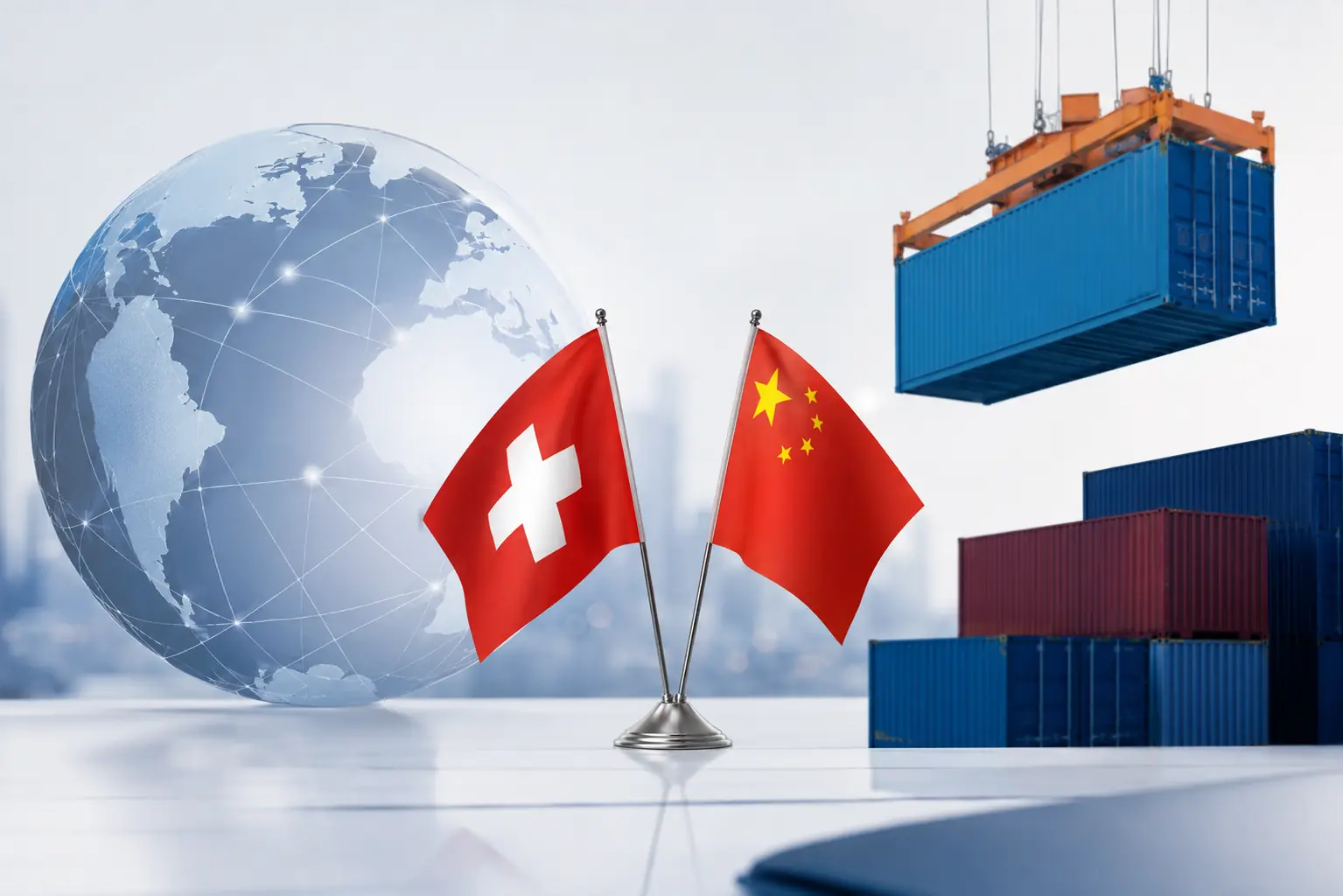
Switzerland and China have concluded negotiations to update the Switzerland–China Free Trade Agreement. This is a development of particular interest to Swiss companies: once the required procedures have been completed, 99.8% of current Swiss exports could enter the Chinese market duty-free.
The result could translate into greater competitiveness for Swiss companies exporting to China, as well as new opportunities for those considering entering or expanding in the Asian market.
The agreement, however, is not yet operational. Following the conclusion of negotiations on 20 August 2026, the agreement will undergo legal review, signature and approval procedures in both countries.
Why the Switzerland–China agreement matters
The current free trade agreement, in force since 2014, has already contributed to promoting trade between the two countries. However, an important asymmetry remains: while almost all Chinese imports into Switzerland are duty-free, this treatment currently applies to only around half of Swiss exports to China.
The update to the agreement therefore aims to significantly reduce this gap.
China is Switzerland’s third-largest trading partner, after the European Union and the United States. In 2025, trade between Switzerland and China reached CHF 33.5 billion.
For Swiss companies, improved access to the Chinese market therefore means not only reducing potential import costs, but also increasing their ability to compete in one of the world’s major markets.
Potential savings of CHF 244 million
According to estimates by the Swiss Confederation, the updated agreement could generate overall savings of around CHF 244 million per year on Swiss exports.
The benefit, however, will not be the same for all products and may not necessarily be immediate.
Gradual tariff reductions and transitional periods are envisaged for certain categories of goods. Potentially affected sectors include watchmaking, pharmaceutical products, machinery and chemicals, areas in which Switzerland has significant expertise and a strong export orientation.
Particularly long transitional periods are also envisaged for certain agricultural categories.
What does this mean in practical terms for a Swiss company?
The first consequence is clear: the reduction or elimination of tariffs can directly affect the cost of accessing the Chinese market.
But the competitive advantage does not stop at the customs tariff.
For a company exporting to China, the benefit can be assessed from several perspectives: selling price, margin, competitiveness compared with international competitors, and the possibility of reinvesting part of the savings in business expansion.
For example, a company could choose to pass part of the benefit on to customers through more competitive pricing, or retain it to improve its margin. In other cases, the savings could help finance marketing, distribution, after-sales services or business development activities in China.
The new agreement can therefore become an element to be integrated into the broader internationalisation strategy of a Swiss company.
It is not just about tariffs
One of the most interesting aspects of the updated agreement is that the revision does not concern customs tariffs alone.
The new framework also covers rules of origin, trade facilitation, trade in services, digital trade, competition, and economic and technical cooperation.
Rules of origin remain essential
To benefit from the preferential treatment provided for under a free trade agreement, it is not enough for a product simply to be shipped from Switzerland to China.
It is necessary to determine whether the product meets the preferential rules of origin established under the agreement. This aspect can be particularly important for companies using components, raw materials or semi-finished products sourced from different countries.
Correct classification of goods, origin documentation and supply chain management therefore become essential elements for effectively taking advantage of the agreement.
Services and digital trade
The update also covers trade in services and digital trade.
This is a significant development because internationalisation no longer relies solely on the physical sale of products.
Consulting, technology services, digital solutions, support services and other activities can represent an increasingly important part of a Swiss company’s international business.
For SMEs, this means looking at the Chinese market not only as a destination for their goods, but also as a potential market for services, expertise and innovative solutions.
An opportunity, but also a strategic decision
The agreement should therefore not simply be interpreted as “lower tariffs”. For a Swiss company, the real issue is understanding how to use the new trading environment as part of its strategy.
A reduction in customs costs can change the profitability of a particular product line. It can make a market that previously offered margins that were too low more attractive. Or it can strengthen an already established commercial presence.
Before making decisions, however, it will be necessary to know the final terms of the agreement in detail and understand the timetable for its implementation.
What should a company assess?
For a Swiss company operating, or intending to operate, in the Chinese market, it may be useful to start assessing:
- which products could benefit from the new tariff conditions;
- what tariff rates currently apply to exports;
- whether the products comply with the future preferential rules of origin;
- what impact tariff reductions could have on margins;
- whether prices and commercial terms should be adjusted;
- whether the international supply chain is structured consistently with the new opportunities;
- which services or digital activities could be developed in the Chinese market;
- which commercial investments could become more attractive.
This analysis can be particularly important for Swiss SMEs, which often have highly competitive products and expertise, but need to carefully assess the costs, risks and complexity of international expansion.
The importance of planning
Changes in international trading conditions should not be considered in isolation: tariffs, taxation, corporate structure, financing, trade flows, supply chain management and market strategy are all elements that can influence one another.
For this reason, the update of the Switzerland–China Free Trade Agreement may be a good opportunity to review the company’s export and internationalisation strategy.
This does not necessarily mean deciding today to enter the Chinese market. Rather, it means determining whether, in light of the new conditions, a particular commercial strategy could become more attractive than it was in the past.
The Fidav perspective
The update of the Switzerland–China agreement represents a positive signal for the Swiss economy and for export-oriented companies.
The figure of 99.8% of exports potentially becoming duty-free is significant, but it is not sufficient on its own to determine whether a transaction is economically attractive. The real benefit comes from the company’s ability to translate regulatory change into a well-informed economic decision.
It is therefore useful to prepare in advance: analyse your trade flows, verify the applicable rules, estimate the impact on margins and assess how the new opportunities can be integrated into the company’s strategy.
Conclusion
The updated Switzerland–China Free Trade Agreement could open a new phase for Swiss exports. Lower tariffs, together with new provisions on trade, services, investment and digital activities, may create more favourable conditions for companies looking towards the Chinese market.
The opportunity, however, is not automatic: understanding the new rules and preparing in good time will be essential to turning a regulatory change into a tangible competitive advantage.
Would you like to assess the opportunities for your company?
If your company exports to China or is considering new international markets, now is the right time to analyse the impact of the new trading conditions.
Fidav can help you assess the tax, corporate and financial aspects connected with your internationalisation strategy. Contact us to explore the opportunities for your company.
Let's talk
Does this topic concern your business too? Let's meet.
Half an hour of conversation does more than a thousand emails. Chat with us on WhatsApp or let's book a meeting: no commitment, no costs.